Implementation of K3
This implementation aims not only to meet international accreditation standards, but also to protect the entire academic community because K3 is one of the core scientific fields taught in Industrial Engineering.
Implementasi K3
The Department of Industrial Engineering, Diponegoro University, is fully committed to implementing Occupational Safety and Health (OHS) as an effort to control potential hazards and protect the entire academic community within the UNDIP Industrial Engineering environment. Our commitment is supported by the Occupational Safety and Health (OHS) policy of the UNDIP Faculty of Engineering, which can be accessed at the following link: https://k3.ft.undip.ac.id/about/kebijakank3/
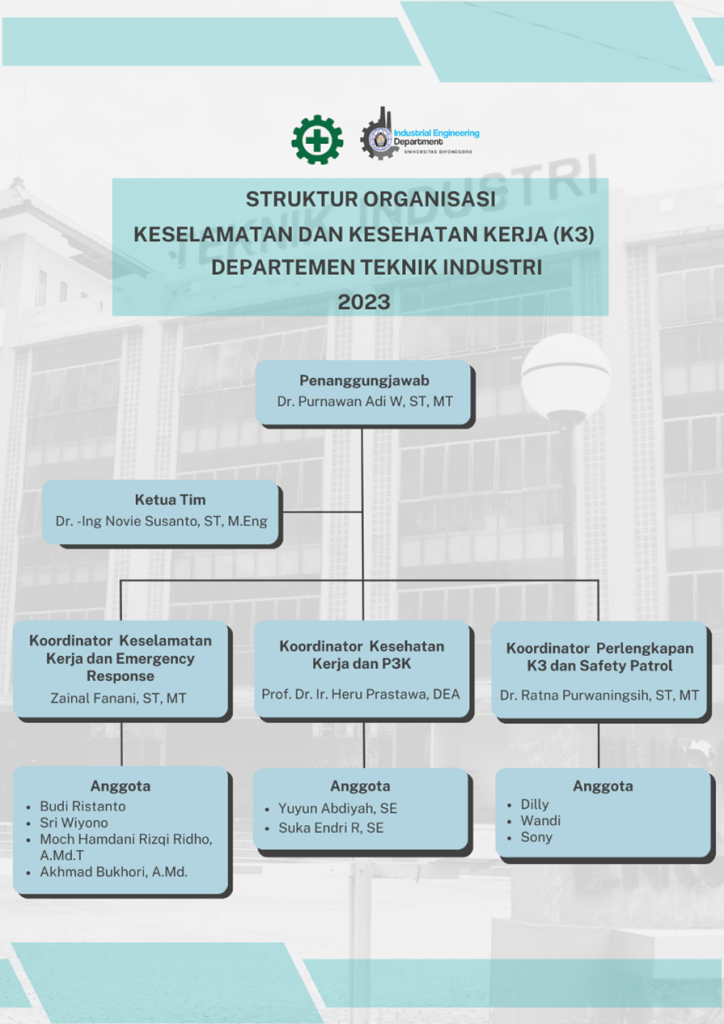
As a manifestation of our commitment and commitment to OHS implementation, the following is the organizational structure of the Occupational Health and Safety (OHS) in the UNDIP Department of Industrial Engineering. The following are the facilities, infrastructure, and supporting facilities for OHS implementation in the UNDIP Department of Industrial Engineering:
Fire Handling Support
- The Industrial Engineering Department has two types of firefighting equipment: portable fire extinguishers (APAR) and fire blankets.
- Every campus area is equipped with APARs (dry chemical powder and carbon dioxide) to extinguish fires and prevent their spread.
- Firefighting training is routinely conducted for the entire UNDIP Industrial Engineering academic community to provide a basic understanding and knowledge of firefighting efforts.
Emergency Response
- Each room has an emergency evacuation route map and exit signs to guide safe exits in the event of an emergency.
- The Industrial Engineering Department has a Standard Operating Procedure (SOP) for evacuation and handling of workplace accidents. The Industrial Engineering Department’s SOP document for the Evacuation Process and Workplace Accident Handling:
- Each evacuation route map includes information on important telephone numbers to contact in an emergency.
Safety Induction
- Safety Induction videos are shown before each class or activity begins to provide information about the various potential hazards within the Industrial Engineering Department and their control measures.
- Department of Industrial Engineering Safety Induction Video: https://www.youtube.com/watch?v=enL9qvEnJEc
Potential Hazard Monitoring
- SOPs for Practical Work and Activities in the IT Environment. There are procedures that must be followed when conducting practical work and other activities in the Industrial Engineering environment. These procedures include:
1. Wearing appropriate attire
2. Speaking politely
3. Maintaining ethical and polite behavior
4. Maintaining the cleanliness and security of campus facilities and equipment
5. Following evacuation instructions in the event of an emergency
6. Maintaining security and order on campus. - Work Permit. Before a practical work session begins, a Job Safety Analysis (JSA) is completed to identify potential hazards, analyze risks, and determine control measures and safety procedures for the activity to be carried out. The JSAs for the Work Systems Engineering and Ergonomics Laboratory (RSKE), the Lean and Sustainable Supply Chain Laboratory (LSSC), the Decision Support System Laboratory (DSS), and the Production Systems Laboratory (LSP) can be accessed at the following links:
Health Facilities
- On every floor and in every laboratory, there are first aid kits stocked with medical equipment for providing first aid in the event of an injury or accident.
- There is a health room for minor health concerns for the UNDIP Industrial Engineering academic community.
- There are facilities for disabled people, including wheelchairs and ramps.